Here we are, new in 2024 but for the majority – same old problems. I have promised in one of my previous posts (Difficult Conversations) to write more about conflict in all relationships we have, regardless of the nature of it. Although it is a new year, new me – I still hate the conflicts but at the same time, I am embracing that they are part of life. On top of being in our lives whether we want it or not, conflicts can be crucial catharsis in our relationships, and the good news is we can also learn how to become better at it. We all have our conflict styles that we have learned through our family of origin, often observing our caregivers fighting and later subconsciously most likely repeating them with people in our lives. This is actually a crucial detail to be aware of; all our partners, friends, colleagues have their own conflict pattern/style which often times is probably not the best and the healthiest. We are all trying to navigate this discomfort of conflict in the best way we can.
Some of us grew up in environments that were highly charged and confrontational. This can lead someone to navigate towards them because it is the only way they feel they can get across their needs and hurt, while some run away from conflict in the fastest way possible. The through line in all conflicts is pain and hurt; someone, somewhere has said or done something that caused us pain and vice versa. For me, that has been such an important realization because behind every loud, lashing out episode of people in my life, I have realized there was pain. Most specifically, the feeling of helplessness, which is scary. We can choose to get loud, use name-calling, but we can also choose to retract and become silent and withdrawn. I think it is so important to talk with people in your life who are your chosen family. What conflict styles have you each learned and brought into the relationship? Understanding each other is the first step to change (if you want to work on it). So often, knowing why your partner reacts in a certain way, and that it has nothing to do with you, can help in how you will react to it.
Listening seems to be such a big issue for everyone; we are all listening to respond without actually hearing what the other side has to say. What are we so afraid of? It seems like there is a perception of loss if you take your time to respond, like the faster our response is, the more chance we have of winning in conflict, but who exactly are we trying to defeat? If the answer is the opposite side, then I am asking myself – do I want to defeat the person I love for the sole purpose of winning? I leave the response up to you; it is personal. I have learned recently such an eye-opening fact about how often we are in conflict with each other rather than teaming up as a couple against our ever-returning problem or issue. Meaning, if the conflicts are happening around the same topic, try to address the topic as a problem and find a solution, rather than attacking each other – attack the problem together. The most common example is dishes or tardiness of one partner; instead of attacking the partner for never doing dishes on time or being ready on time – try discussing the problem from a different perspective of what you can both do to ensure the problem does not cause the conflict?
I read recently in one of my readings, that one partner was always late while the other was always waiting, so they decided that the waiting partner will get the party going while waiting – have a drink, turn on music, watch something and not focus on the other one being late. What happened then is that the late partner didn’t want to miss the pleasure of the first drink or good music so they actually made sure to be more on time so they can enjoy together. Obviously, this is a basic example but the point is in reframing the problem as the one that needs the attack and not each other.
Few questions/exercises to do with the partner/friends:
- What have you observed in your home of origin when it comes to conflicts?
- What do you think in your conflict style is the replication of those observed?
- Is there anything in your conflict management you would like to change? Can I help you?
- What triggers or hurts you the most in my conflict style?
- What are the repeating topics/issues we constantly fight about? Can we attack them together?
Often, we connect anger, lashing out, and rage as the main causes of conflict, but in fact Dr. John and Julie Gottman from The Gottman Institute have, through their extensive research, identified the so-called Four Horsemen that are the biggest reasons for relationship deterioration and break-ups. I have broken them down below in more detail, but before jumping into them, I wanted for a second to touch upon anger. Anger, the experience and expression of it, has huge importance in our lives and our health. The way we experience anger and process it comes directly from whether we were able to express it as children. Very often, little girls were taught that anger is not a nice emotion for girls to feel or express, while boys were much more encouraged to do so as it seemed more appropriate. As a result, many women never allow themselves to feel the anger, let alone express it, which the body then internalizes and accumulates. This can lead to different health issues, as the body needs to release those heavy feelings somewhere. On the other hand, we have people who can have these huge outbursts of rage that we believe is an expression of anger, but in fact, it is the opposite side of repression – just another way of abnormally releasing anger. Both ways are actually ways of running away from experiencing anger and anxiety that is there as we are trying to avoid anger. This came as a complete shock to me when I recently read the book “When the Body Says No” by Gabor Maté – anger is a complete physiological experience, a surge of power, and a complete disappearance of anxiety. Our muscle tension decreases, our mouth opens wider because the jaws are more relaxed, and our shoulders drop. When we feel real anger, it is the energy we are given to stand our ground, to say we matter, but at the same time, boundaries are respected. Standing up for ourselves does not have to disrespect the boundaries of the other side.
Finally we have arrived to revelation of the so called Four Horseman that are slow killers of relationships:
- Criticism – this is often confused with complaint or giving an advice which both are addressing specific issues. Criticism includes attacking the core character of the person and dismantling of their core being. This one usually opens the way to the other horseman to show up and further destroy the relationship.
- Contempt – leaves other side feeling despised and worthless, while we give ourselves moral superiority over the partner. This one is truly mean and can include ridicule, name calling, eyeballing, disrespect or scoffing. This one is also the greatest predictor of the breakups/divorces.
- Defensiveness – this one is usually response to criticism, we have all used this one when we feel unjustly accused. Of course, what it does is just giving our partner sign we don’t take their concerns seriously or not taking responsibility over our actions. Often it can include reversing the blame towards the partner and it won’t lead us to healthy conflict resolution.
- Stonewalling – this one is response to contempt and includes withdrawal, shutting down and stopping any responding to the partner. This one usually occurs when we are physiologically overwhelmed and best thing is to ask for a break to recollect your thoughts if you come to this point.
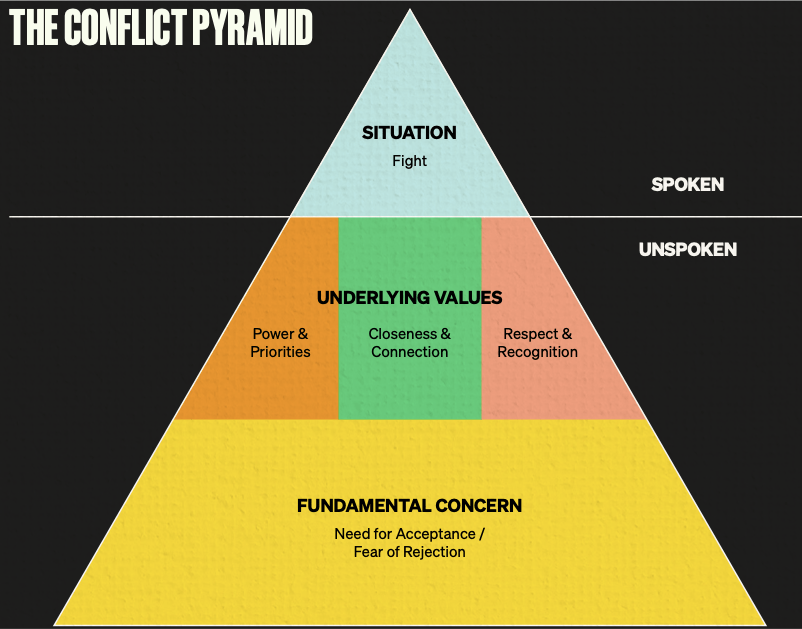
The specific relevant content for this request, if necessary, delimited with characters: I want to leave you with this image as it depicts so beautifully what is happening within us during the conflict and what they are all really about. I do hope you take the time to reflect on how you can improve the well-being of your relationships and learn more about your partner and their experiences with the conflict.
All my love,
Eni
Some amazing resources:
 Dum Amo,Vivo